

Retrofitting your home to make it energy efficient is not a low-cost exercise, so this blog makes suggestions on managing your retrofit costs. Some things are relatively cheap and save money quickly – like cavity fill insulation. Loft insulation is cheap if you can do it yourself – it’s then just the cost of the rockwool insulation, laid to a depth of 300mm.
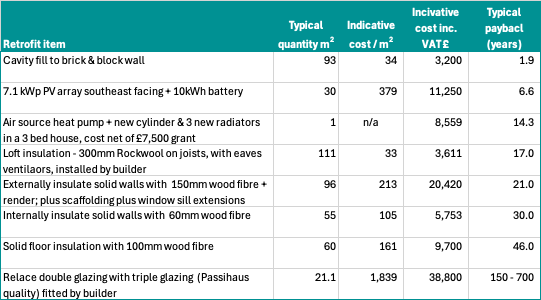
However not everyone can DIY; the table below gives some indicative costs for non-DIY work to improve your home.
Types of retrofit
A “deep retrofit” is one that aims to achieve the Passivhaus ‘EnerPHit’ standard or the AECB Carbon-Lite Retrofit standard. But to get a warmer home the cheapest way is to get an understanding of your expected costs and paybacks – the Whole House Retrofit Plan or the more detailed Passivhaus version will give you this information, tailored to your home – and then you select to do as much as you wish to within your available budget. Retrofit can the a 10 or 20 year project where you work step by step towards a goal defined by comfort or energy usage )or both).
A shorter payback period does not automatically mean ‘better’
You’ll notice that some items have long payback periods, but watch out:
- Some builders will offer internal wall insulation cheaper, and use an oil based product such as Unilin or Xtratherm for the job. But these products cannot ‘breathe’, and can trap condensation within the wall causing mouldy spores to form behind them. A healthy room can become unhealthy and form a danger to health quite quickly is the work is not designed and overseen by a professional (such as an architect or a Retrofit Coordinator who understands moisture management) who can identify, manage and prevent such risks.
- External walls need to be treated differently depending on whether they are cavity brick or solid, and whether they have a properly working damp proof course or not.
- Triple glazing and double glazing have similar overall heat transmittance when averaged over the whole year, but the double lets far more heat out (in winter) and in (in summer) than does triple. Double glazing causes cold draughts in winter, triple eliminates these. So it’s not solely a matter of cost – comfort is a big factor when choosing which type of windows to have.
Looking beyond the individual cost items above, note that Passivhaus planners and builders advise that a ‘deep’ retrofit will cost overall between £1,500 and £2,500 per square metre of floor area. This then is the price of comfort in top-end homes. A home does not have to look blingy to deliver fantastic comfort – it’s what’s under the skin that counts, not what’s on the surface. Note that any external changes to a house require planning approval, so you may need an architect.
Overheating risks need managing too
Well insulated buildings also tend to overheat. The Passivhaus version of the whole house retrofit plan not only tells you if there’s an overheating risk but also whether the steps proposed will manage or eliminate it. I cannot stress how nice it is to live in a house where the overheating and big heat-loss issues have been dealt with.
Links to relevant sites
- The Passivhaus Trust
- The Association for Environment Conscious Building – the AECB
- A Passivhaus Designer in Hove, East Sussex – Jim Miller Design
- Architects in West Sussex that understand how to design for energy efficiency – justine rattray architecture and eskayarchitects